Custom Search

Sunday, August 17, 2008

What is it good for? Absolu. . .well, sausage

A Mainichi Daily News article reports that pictures recently discovered in Chiba prefecture reveal that German prisoners of war in WWI taught their captures how to make sausages.

The article states in part:
The 10 pictures from 1918 show German soldiers, who were detained at the Narashino prison camp in then Ninomiya (present-day Narashino) in Chiba Prefecture, butchering pigs and smoking pork to make sausages.
And in case you doubted the significance of this find, Norio Hotta, who is described in the article as "an expert in the history of meat processing in Japan, has this to say:
"The authentic German art (of sausage making) is pictured, and the photos are precious and significant in that they recorded the beginning of sausage making in Japan."
Damn skippy!
Enjoy your swine Japan.

Thursday, August 7, 2008

Discourse of Tree Planting

Reuters reports that a new report by the Australian National University (ANU) suggests that
uncut forests store about three times the amount of carbon as those that have been planted (plantation forests). The report questions the use of plantation forests in international carbon trading schemes and suggests that there is a need to protect older forests. Click here for a PDF of the full report.

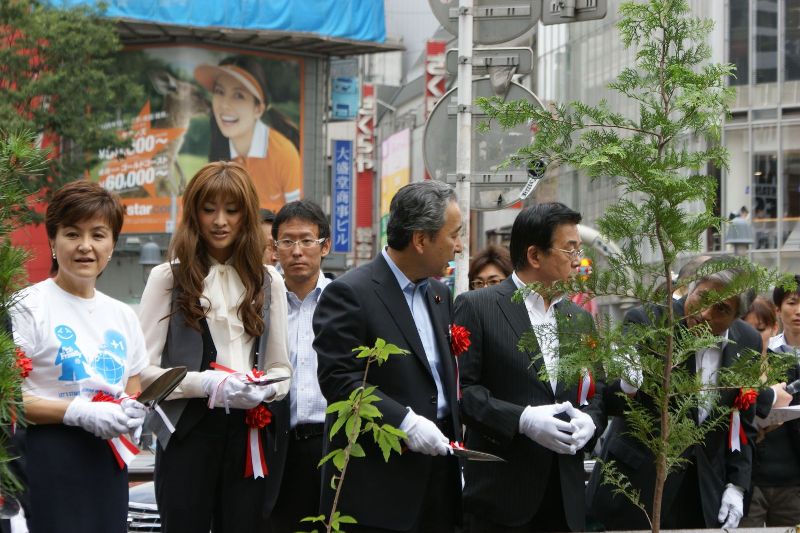
This report calls into question the effectiveness of some of the recent activities in Japan focused on tree planting and carbon offsetting. See the Gaia Initiative's +1 Forest Program.

Approximately 67% of Japan's land area is comprised of "forest" that was heavily cut in the post-war period. Therefore, a large portion of the area is plantation (comprised mostly of cypress and cedar trees). Importation of foreign wood has rendered domestic trees unprofitable and so there is now an overabundance of plantation forests that are simply being abandoned, which is creating a host of new ecological problems for mountain villages (animal pestilence being perhaps the most visible).


At the same time, new global discourses focused on climate change have become very prominent in Japanese popular culture and there is a new "eco" craze, rooted mostly in urban areas. Part of being "eco" means planting as many trees as possible ("let's carbon offset"). The
national forest agency has picked up on this discourse and so tree planting is given legitimacy. The problem is that the trees selected for planting are often the same plantation varieties of which there is already an overabundance. In other words, "eco" discourses give legitimacy to, and seem to even encourage, tree planting that is at best ineffective and at worst ecological disastrous. But, no one seems to think past the discourse: organizations take photos of members planting trees, businesses offer sponsorship, and the forest agency boasts about efforts to combat climate change.

Monday, August 4, 2008

A Properly Shitty Mountain

A Mainichi Daily News article suggested that Japan's Environment Ministry is concerned that a bio-toilet recently placed on the seventh stage of Mt. Fuji's Yoshida route is in danger of overflowing due to overuse.

Thousands upon thousands of visitors to Japan's most "sacred" mountain are sending hopes of attaining World Heritage Site status down the crapper. . .literally.

I have to agree with a recent argument made by D.P. Martinez in a book chapter entitled, "On the 'Nature' of Japanese Culture, or, Is There a Japanese Sense of Nature?", where he suggests that what is often taken as a unique Japanese sense of nature stems largely from a history of elite aestheticism in which the natural was packaged for human consumption. In other words, cultural representations of nature, such as gardens or bonsai trees, should not lead us to assume a unique respect of nature on the part of Japanese.

Mt. Fuji represents this seeming contradiction well. . .a natural symbol of Japan that is yearly degraded by a string of tourists who leave behind human waste and garbage. This is not to say there is no respect for nature in Japan, but it is not homogeneous and inherent. Also, I would argue that the dissemination of discourses on nature from metropolitan areas less a response to the natural world and has more to do with insecurities about Japan's modernity. The portion of Japan's population living in rural areas have to deal with the realities of nature and their discourses reflect this.


-Martinez, D.P. 2008. On the "Nature" of Japanese Culture, or, Is There a Japanese Sense of Nature? in A Companion to the Anthropology of Japan. J. Robertson, ed. Oxford: Blackwell.